Drimia maritima (syn. Urginea maritima)
Bulb native to Portugal occurring in shallow glades of scrubland, forest and pine forests, in rock crevices, open meadows. On stony, clayey or sandy soils. The genus Drimia, belongs to the family Asparagaceae, is comprised of 99 accepted species.
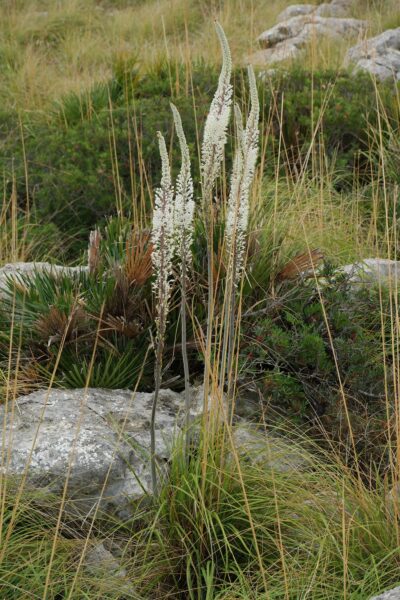

A large bulb growing close to the surface which survives wildfires, flowering in September before the leaves are produced. The 50 – 70 cm tall flower spikes are compound twirling inflorescences with white six petal stars opening along the stem showing dark purple lines inside and out.
Known since the time of Theophrastus as a rat poison and hung as a talisman outside houses in Greece to this day. Medical use as cardiac stimulant. It is a well-known Ayurvedic medicine for skin diseases, intestinal worms, and respiratory disorders. Distribution is Mediterranean basin and Southern Europe, widespread in Portugal, especially in coastal areas.

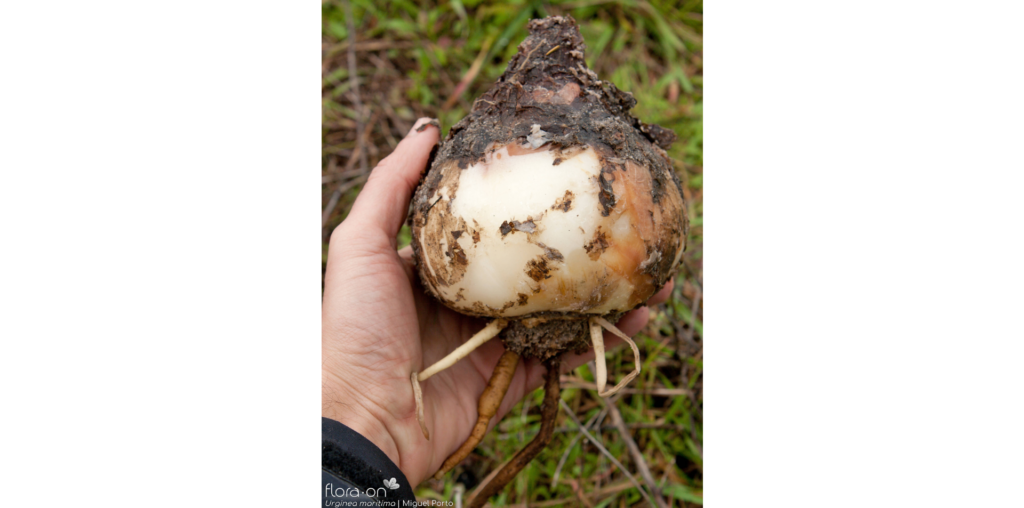
It is not commonly offered for sale, but it is possible to find bulbs occasionally. A good method is to collect seed heads and grow the bulbs onto flowering size, normally within three years.
More info on medicinal use https://www.ncbi.nlm.nih.gov/pmc/articles/PMC6630810/